As complex biologics advance faster than they ever have previously, the gap between scientific innovation and scalable manufacturing infrastructure is widening. Processes that perform reliably at laboratory or early clinical scale often run into new hurdles once batch sizes grow and regulatory expectations tighten.
At the same time, drug developers are under pressure to protect investment, move faster, and prove commercial viability earlier in the development journey. Early decisions around process design, technology transfer, and partner selection can shape the entire product lifecycle making predictability, early process understanding, and flexibility essential.
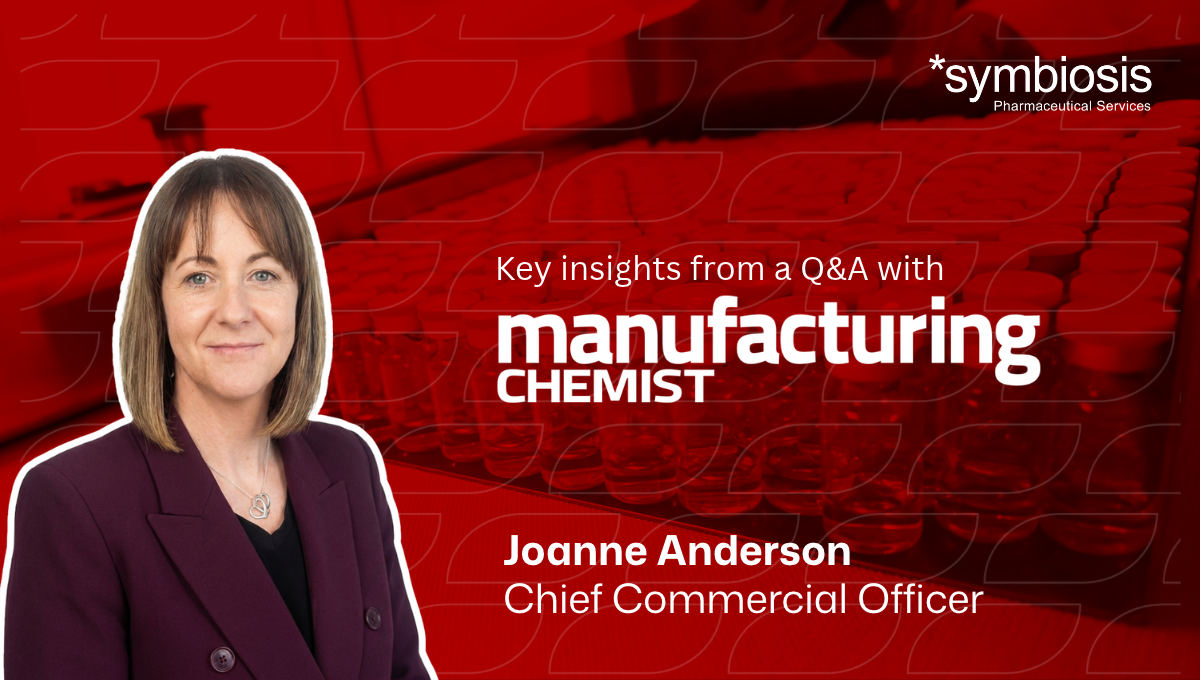
In this Q&A originally featured in Manufacturing Chemist, following conversations and developments at CPHI Milan 2026, Symbiosis Chief Commercial Officer Joanne Anderson shares her perspective on overcoming scale-up bottlenecks, improving consistency, introducing new technologies thoughtfully, and building agile, reliable manufacturing strategies for complex therapies.
Manufacturing Chemist:
Looking back at the conversations and developments at CPHI, as medicines and manufacturing processes become more complex, where are the biggest challenges emerging when moving from development into scalable production?
Joanne Anderson:
One of the biggest challenges is that the science is advancing faster than the manufacturing infrastructure needed to support it. Complex biologics, ADCs, mRNA products, cell and gene therapies, and personalised medicines all introduce unique development and scale-up requirements that are rarely linear. Processes that work successfully at laboratory or early clinical scale often become difficult to reproduce consistently as batch sizes increase and regulatory scrutiny intensifies. At the same time, companies face growing pressure to conserve capital, shorten timelines, and demonstrate commercial viability much earlier in development. This means manufacturing decisions made during early development can have significant consequences later in the product lifecycle. Successful scale-up increasingly depends on selecting partners with deep modality-specific expertise who can help navigate process development, technology transfer, regulatory requirements, and commercial readiness from the outset.
Manufacturing Chemist:
Where is there still the greatest opportunity to improve process control, reproducibility and efficiency?
Joanne Anderson:
There is still significant opportunity to improve process control, reproducibility and efficiency by strengthening process understanding earlier in development and maintaining that knowledge throughout scale-up and commercial manufacture. As products become more complex, the greatest challenges often stem not from individual unit operations, but from variability introduced during technology transfer, scale-up and execution across multiple partners and facilities.
The industry has made considerable progress in analytical capabilities and automation, but there remains scope to better connect development data, manufacturing knowledge and operational decision-making. By combining deeper scientific understanding with real-time monitoring, digital technologies and robust process design, manufacturers can identify potential issues earlier, reduce variability and improve consistency.
Ultimately, the biggest gains will come from making manufacturing more predictable rather than more complicated. Organisations that invest in process knowledge, collaborative partnerships and scalable manufacturing strategies will be best placed to improve efficiency while maintaining the quality and reliability that patients depend on.
Manufacturing Chemist:
How can manufacturers introduce new technologies and more advanced processes without adding unnecessary complexity, cost or risk to production?
Joanne Anderson:
The key is to focus on technologies that solve clearly defined problems rather than adopting innovation for its own sake. Manufacturers should begin by identifying where risk, inefficiency, or variability exists within a process and then evaluate whether new technologies can address those specific challenges.
A phased implementation approach is often the most effective. Rather than transforming an entire operation at once, companies can introduce new analytical tools, automation capabilities, or digital systems in targeted areas where measurable benefits can be demonstrated. Strong governance, robust process understanding, and early collaboration between sponsors and manufacturing partners are also critical. The most successful partnerships are built around shared objectives, transparency, and long-term planning rather than purely transactional relationships. When technologies are introduced within that framework, they are more likely to enhance operational performance while maintaining compliance, controlling costs, and reducing execution risk.
Manufacturing Chemist:
Looking ahead, which manufacturing technologies or approaches will be most important in helping the industry scale increasingly complex products while maintaining consistent quality?
Joanne Anderson:
The future will be shaped less by any single technology and more by the industry’s ability to combine specialised expertise with smarter manufacturing strategies. Advanced automation, digital process monitoring, artificial intelligence-driven data analysis, and increasingly sophisticated PAT systems will all play important roles in improving consistency and enabling faster decision-making.
Equally important will be the continued development of specialised manufacturing centres of excellence. As therapies become more complex, many sponsors are recognising that deep technical expertise can provide greater value than broad but less specialised capabilities. We are also likely to see increased use of strategic manufacturing networks, where different partners contribute expertise at specific stages of development and commercialisation. This approach allows organisations to balance flexibility, efficiency, and risk management while ensuring that product quality remains consistent as manufacturing scales.
Ultimately, the manufacturers that succeed will be those that combine scientific expertise, robust process understanding, and carefully applied innovation to create production environments that are both agile and reliable. In an increasingly complex therapeutic landscape, consistency will remain the true measure of manufacturing excellence.
Ready to Discuss Your Next Programme?
Contact us to talk through your development timelines and manufacturing strategy and find out how Symbiosis can help accelerate those timelines, secure faster product release and get your life-changing therapy to patients who need it most.