
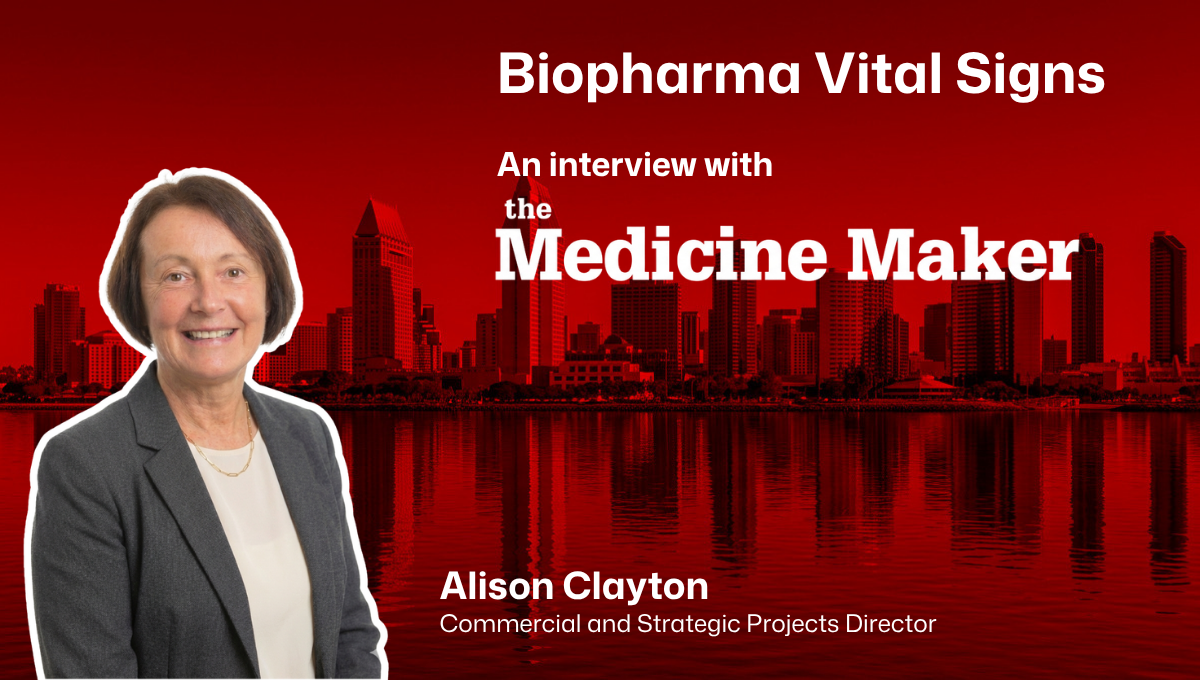
As part of their coverage of Bio International 2026 in Boston, Symbiosis Commercial and Strategic Projects Director Alison Clayton was invited to take part in a roundtable discussion with The Medicine Maker.
Their article, Biopharma Vital Signs, quizzed industry leaders on their views of the state of biotech and biopharma today – including the conversations likely to dominate BIO 2026, the trends shaping development, and the pressure points that could determine which therapies successfully reach patients.
Read Alison’s full interview below:
Medicine Maker
What trends are currently shaping the way biotech and biopharma companies approach development, manufacturing and commercialisation?
Alison Clayton
One of the most significant trends is the increasing complexity of therapeutic pipelines. Biologics, advanced therapies and specialised injectable medicines are placing new demands on development and manufacturing, requiring highly specialised expertise to support successful progression from early development through to commercial supply.
We’re seeing a shift in how companies approach outsourcing and partner selection. Rather than simply looking for capacity, many sponsors are prioritising partners with deep technical knowledge and proven experience within specific modalities. The ability to navigate complexity, manage risk and provide practical development insight is becoming an increasingly important differentiator.
At the same time, the funding environment remains challenging, particularly for emerging biotechs. Investors and stakeholders are placing greater emphasis on capital efficiency and the ability to demonstrate a credible path to commercialisation. This is encouraging more companies to think more carefully about manufacturability, scalability and long-term product viability alongside scientific innovation.
Finally, resilience continues to be a major focus across the industry. Geopolitical uncertainty, supply chain disruption and capacity constraints have reinforced the importance of building flexibility and risk mitigation into development and manufacturing strategies. Increasingly, success depends not only on advancing innovative science, but on creating robust pathways that can reliably deliver therapeutics to patients.
Medicine Maker
What conversations do you expect to be prominent at BIO 2026, and why?
Alison Clayton
I expect many of the conversations at BIO 2026 will centre on a common challenge facing the industry: how to translate scientific innovation into successful and sustainable development programmes.
The pace of innovation across biologics, advanced therapies and precision medicines remains incredibly strong, but organisations are operating in an environment where funding remains selective, and stakeholders are placing greater emphasis on execution. As a result, discussions are increasingly shifting from what is scientifically possible to how promising therapies can be developed, manufactured and commercialised efficiently.
I also expect supply chain resilience and manufacturing readiness to remain high on the agenda. Recent years have highlighted the importance of securing reliable access to specialised expertise, capacity and materials, particularly for complex products where development and manufacturing challenges can significantly impact timelines.
Finally, the role of technology and data will continue to generate significant discussion. While AI and digital tools offer considerable potential, the focus is increasingly moving beyond the technology itself towards how these capabilities can be applied in practical ways to improve decision-making, reduce risk and accelerate development.
I think BIO 2026 will reflect an industry focused not only on innovation, but on creating realistic pathways to bring that innovation to patients successfully.
Medicine Maker
Where are companies feeling the greatest pressure as they try to move therapies from discovery into the clinic and, ultimately, toward commercial readiness?
Alison Clayton
One of the greatest pressures facing companies today is balancing speed with long-term readiness. In a competitive and capital-conscious environment it is no longer enough to demonstrate scientific promise without also considering whether a product will still represent a compelling commercial opportunity by the time it reaches market. Development timelines can span many years, and competitive landscapes can change significantly during that period.
This challenge is particularly evident for complex biologics and advanced therapies, where manufacturing processes, analytical methods and supply chain requirements become increasingly demanding as programmes progress. Decisions made early in development can have significant implications for future scalability, cost and commercial viability, making it essential to maintain long-term perspective while continuing to advance at pace.
Resource constraints remain a significant factor, especially for emerging biotechs. Lean teams are often required to manage increasingly complex development programmes, increasing the importance of accessing external expertise and capabilities at the right time.
Ultimately, organisations are navigating scientific, regulatory, operational and commercial uncertainties simultaneously. Those that can take a holistic view of these interconnected challenges and balance immediate objectives with future market realities are often best placed to achieve commercial success.
Medicine Maker
How are partnership models changing across the biopharma ecosystem?
Alison Clayton
As therapies become more complex, partnership models are evolving beyond the traditional customer-supplier relationship. Increasingly, companies are looking for partners who can contribute expertise, provide strategic input and help navigate challenges, rather than simply deliver against a predefined scope of work.
Many emerging biotech companies operate with lean teams and rely on external partners to supplement their internal capabilities. As such, partnerships are becoming more integrated and collaborative, creating greater demand for relationships that enable knowledge sharing, problem-solving and access to specialist expertise. In this environment, partner selection is no longer based solely on technical capability. Companies are also placing greater emphasis on organisational fit, recognising that factors such as culture, communication style and ways of working can have a significant impact on long-term success.
We’re also seeing greater emphasis placed on alignment across the wider development journey. Decisions made in one area of a programme can have significant implications elsewhere, whether that’s manufacturing, regulatory strategy, supply chain planning or future commercial readiness. Strong partnerships help create visibility across these interconnected activities and support more informed decision-making.
The most effective partnerships are those where both organisations are working towards the same outcome. The focus is becoming less about individual transactions and more about combining expertise to overcome challenges, reduce risk and help promising therapies reach patients successfully.
Medicine Maker
What capabilities are becoming most important for companies that want to make drug development faster, more flexible and more resilient?
Alison Clayton
While technical expertise remains fundamental, one of the most important capabilities today is the ability to adapt. Drug development rarely follows a perfectly linear path, particularly for novel and complex therapies, so organisations need the flexibility to respond effectively to changing data, evolving programme requirements and external challenges.
Cross-functional collaboration is also becoming increasingly important. Development, manufacturing, regulatory and commercial considerations are more interconnected than ever, and organisations that can bring these perspectives together early are often better equipped to make informed decisions and avoid downstream obstacles.
Another critical capability is access to specialist knowledge. As therapeutic modalities become more sophisticated, companies increasingly rely on expertise that may not exist within their own organisations. The ability to identify and engage the right external partners can therefore have a significant impact on programme success.
Finally, resilience depends on visibility and proactive risk management. Whether addressing supply chain challenges, capacity constraints or development risks, organisations that can anticipate issues and respond quickly are often better positioned to maintain momentum and achieve their objectives. In an increasingly complex environment, agility and foresight are becoming just as valuable as scientific excellence.
Medicine Maker
What practical advice would you give to emerging biotech companies navigating today’s development, funding, and manufacturing environment?
Alison Clayton
My first piece of advice would be to think beyond the next milestone. Funding pressures can understandably create a focus on immediate objectives, but it is important to consider how early development decisions may affect future clinical progression, manufacturing scalability and commercial readiness.
Engaging experienced partners early can be particularly valuable. Whether the challenge relates to manufacturing, regulatory strategy or CMC planning, gaining expert input at the right stage can help avoid delays, reduce risk and ultimately make better use of limited resources. It is often more cost-effective to address potential issues proactively than to correct them later when programmes are further advanced.
I would also encourage companies to be selective when choosing external partners. The right partner should offer more than capacity; they should bring relevant expertise, a strong quality culture and a genuine understanding of the specific challenges associated with the therapy being developed. For complex biologics and advanced therapies especially, deep technical knowledge can be a significant differentiator.
Lastly, maintain a clear focus on the patient and the intended commercial outcome. Scientific innovation remains fundamental but successful programmes increasingly combine strong science with thoughtful planning, strategic partnerships and a realistic understanding of the path to market.
To discuss an upcoming drug product and find out how Symbiosis can offer rapid access to manufacturing slots, get in touch.